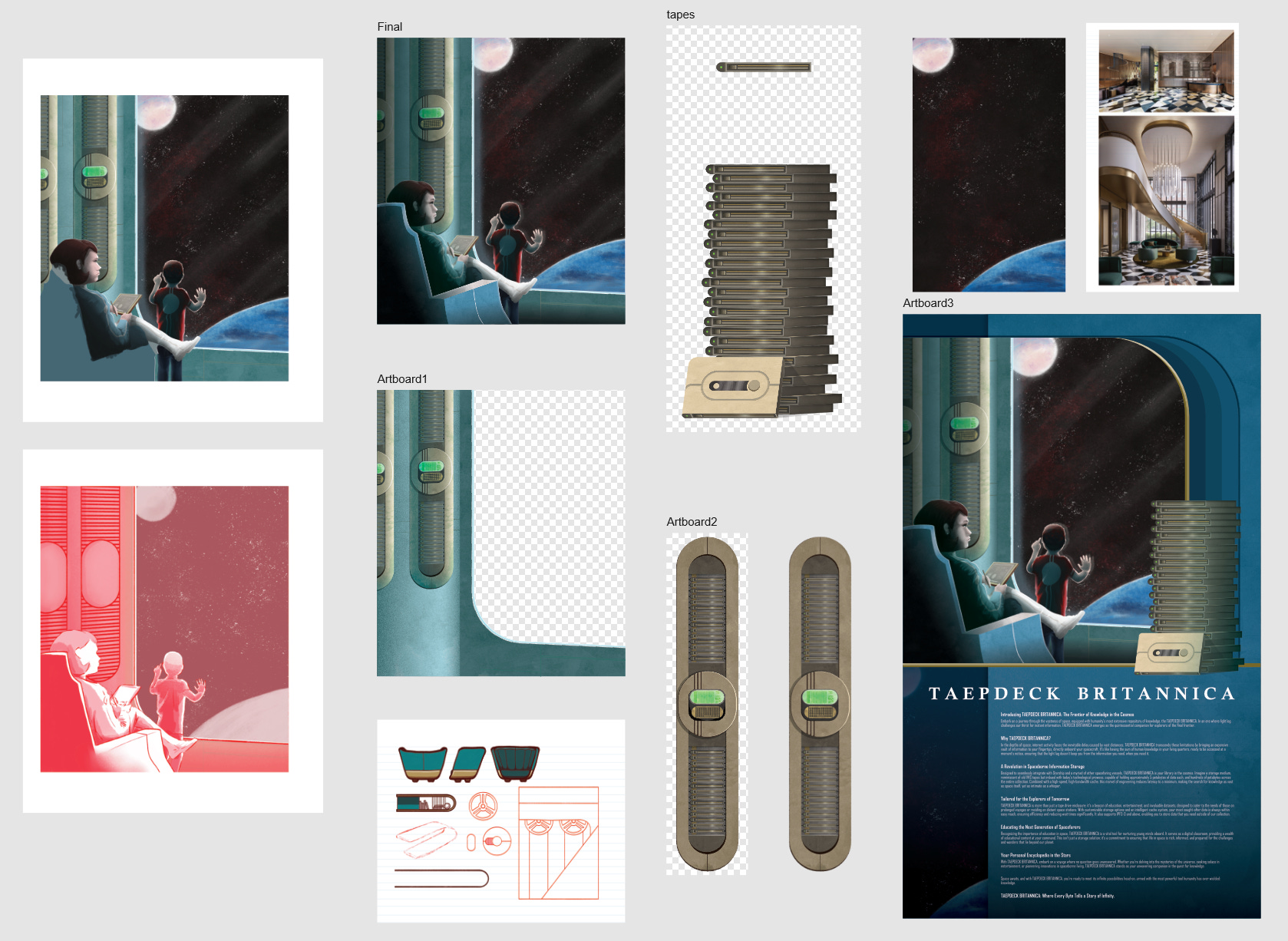
Internal Notes on the creation of TAEPDECK BRITANNICA
by Charles Rosenbauer
As a result of light lag, network latency in space is very high, making a large amount of common internet activity impractical or inconvenient. In some ways this makes communication more like older times, albeit it with much grander scales and volumes.
One consequence is that storing large volumes of information locally becomes much more valuable, as its close proximity mitigates light lag. The information that is stored may be far less volatile than say, social media; no second-by-second updates. Requesting files, web pages, and more may take minutes or hours depending on how distantly the data is stored.
TAEPDECK BRITANNICA is a product meant to fit into spaceships, compatible with Starship, but also with various Aldrin Cyclers and similar ships that will tend to be more common for actual transport between planets, moons, asteroids, lagrange points, space stations, and so on.
If the technology of today were scaled up and improved, a cassette comparable to an old VHS tape with the magnetic information density of a modern hard drive could easily store ~5 petabytes (5000 terabytes) of storage. The tape medium does bring back a problem with latency, as tapes must be wound and unwound to the right position to read, which could take minutes, though there are a variety of things that can be done to make this more acceptable.
The high volume of storage means that small files demanded more frequently could simply be duplicated many times such that there is always one “nearby” on the tapes. Another option would be a cache, which could easily scale to store several tens of terabytes of frequently-accessed data.
TAEPDECK BRITANNICA is a collection of tape drives in an enclosure, as well as including some SSDs as a cache. The exact contents may consist of entertainment, educational content, datasets, code, and a variety of other forms of data that may be of interest to someone on a months-long travel through space, or alternatively someone living long-term on a space station far from a popular data center. Exactly what is stored, how much cache and storage is provided, and perhaps some configuration options for how it is stored (latency vs. duplication tradeoffs, etc.) forms customization options.
One problem with space internet is that data on the internet today is organized heavily around location of data via URLs rather than what the data is. The IPFS (Interplanetary File System) protocol was designed in response to this problem, which locates files using cryptographic hashes rather than addresses. The intention was that hashes are a very powerful tool for making files tamper-proof so that you can be confident that you’re getting the correct file, while also making the system agnostic to the exact location of the data; it could be stored on a server anywhere on Earth, or it could be grabbed from a server on Mars if that is closer to where you are. Individual users can donate hard drive space to contribute to the storage across the network. The protocol is widely used among certain crypto projects today, though it faces various technical and incentive problems for maintaining a distributed file system and efficiently locating and distributing content. I expect that future protocols or versions of the protocol will eventually solve these problems, though it might require a more nuanced vision and a less absolute approach to being agnostic to location.
Additionally, it might be worth mentioning education of children as an application, as this was a major selling point of encyclopedias mentioned in a lot of their marketing. Space also needs a place for children and parents to be sustainable.
Concept Art and Stylistic Iterations