On THE THIRD PLACE — a mile-long community center suspended in the clouds — a young director sets out to film a documentary about its most famous muse, who turns out to be very much alive and watching.
Molly Gernsback has never made a good film and never will. Her only artistic trait is that knowledge of that fact doesn’t keep her from trying. Just six projects into her career, she’s made a name for herself as a director of movies perfectly crafted for a semi-literate audience too smart for pop films. Everything she makes can only be described, at least by anyone with actual taste, as ‘cute’, before it can be described as ‘good’.
With the release of this year’s Oscar nominations, ever the North Star of the industry’s darlings, Molly is luxuriating in praise for her Best Picture nomination for Titanic Part II, engorged with winking satire and metatextual flair with a silly premise everyone can’t shut up about: The fictional account of a film crew’s tragic attempt to film a sequel to Titanic on a space station, with disastrous and deadly results. Gernsback set out to follow in Cameron’s footsteps and make cinematographic history with the postmodern romantic disaster sci-fi epic being the first major studio film to be shot entirely in space, which fortunately did not end up like the film within the film. A fresh-faced 108-year-old Leonardo DiCaprio stars as a parodic version of himself as the aging director obsessed with capturing the glory of his past. He’s received his obligatory Best Actor nom. Perhaps this will finally be his second win. Many have already remarked on his new relationship with the latest model, the 23-year-old viral phenom Jocelyn Burns, seen on his arm this week. Leo must have admired Molly’s comparable groping at a past she can never return to.
To see where an ‘artist’ (being generous) is going, you remember where they came from. With all their success, the early work, the student filmography of many directors, even the most celebrated, is rarely ever approached by anyone but devoted fans and self-described cinephiles. Few have seen Molly’s first film, a student documentary with notable connections to her latest hit, an amateur film chronicling her relationship with everyone’s favorite hangout in the clouds, THE THIRD PLACE, itself a metaphorical Titanic with wings, and its greatest muse, Ira Blue.
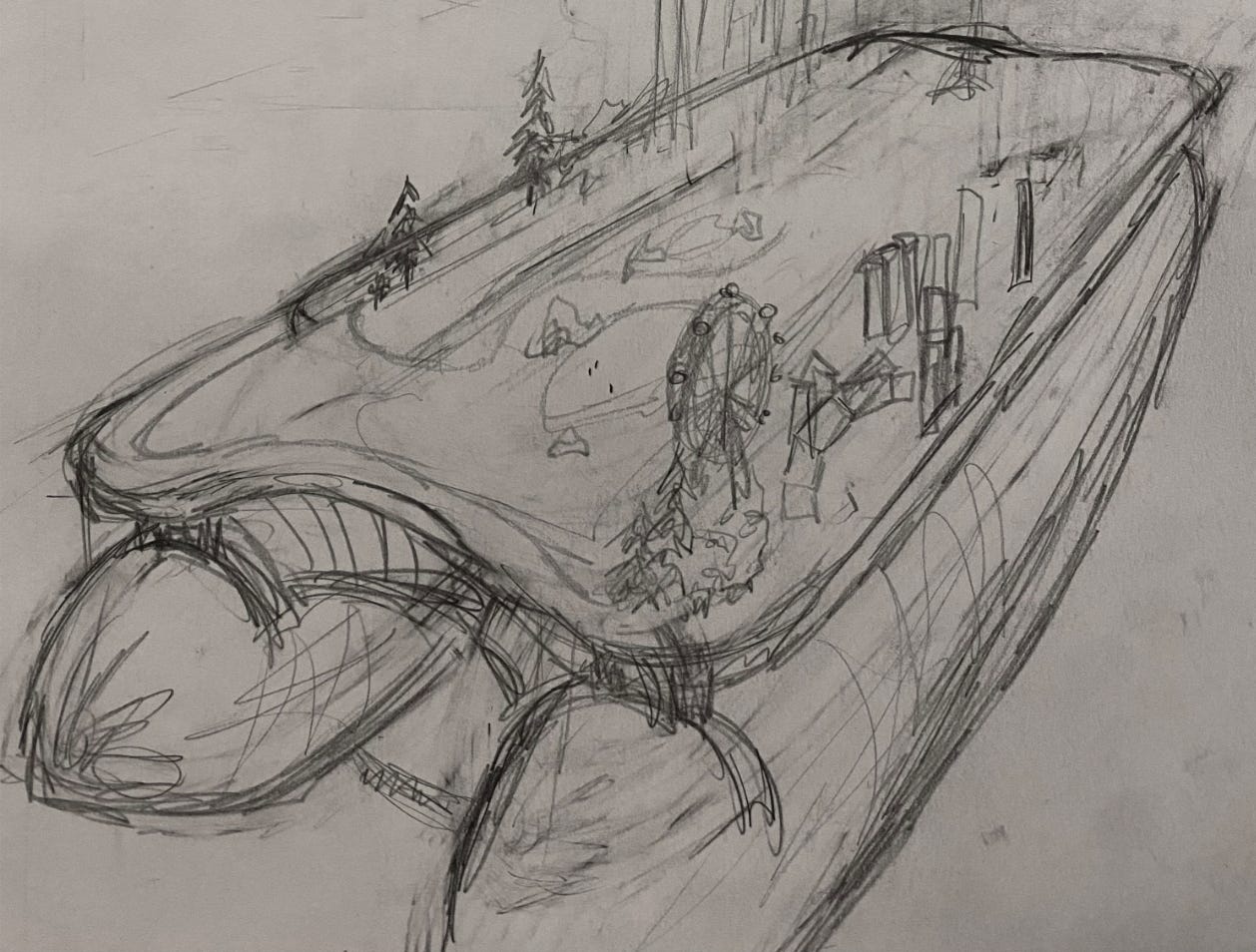
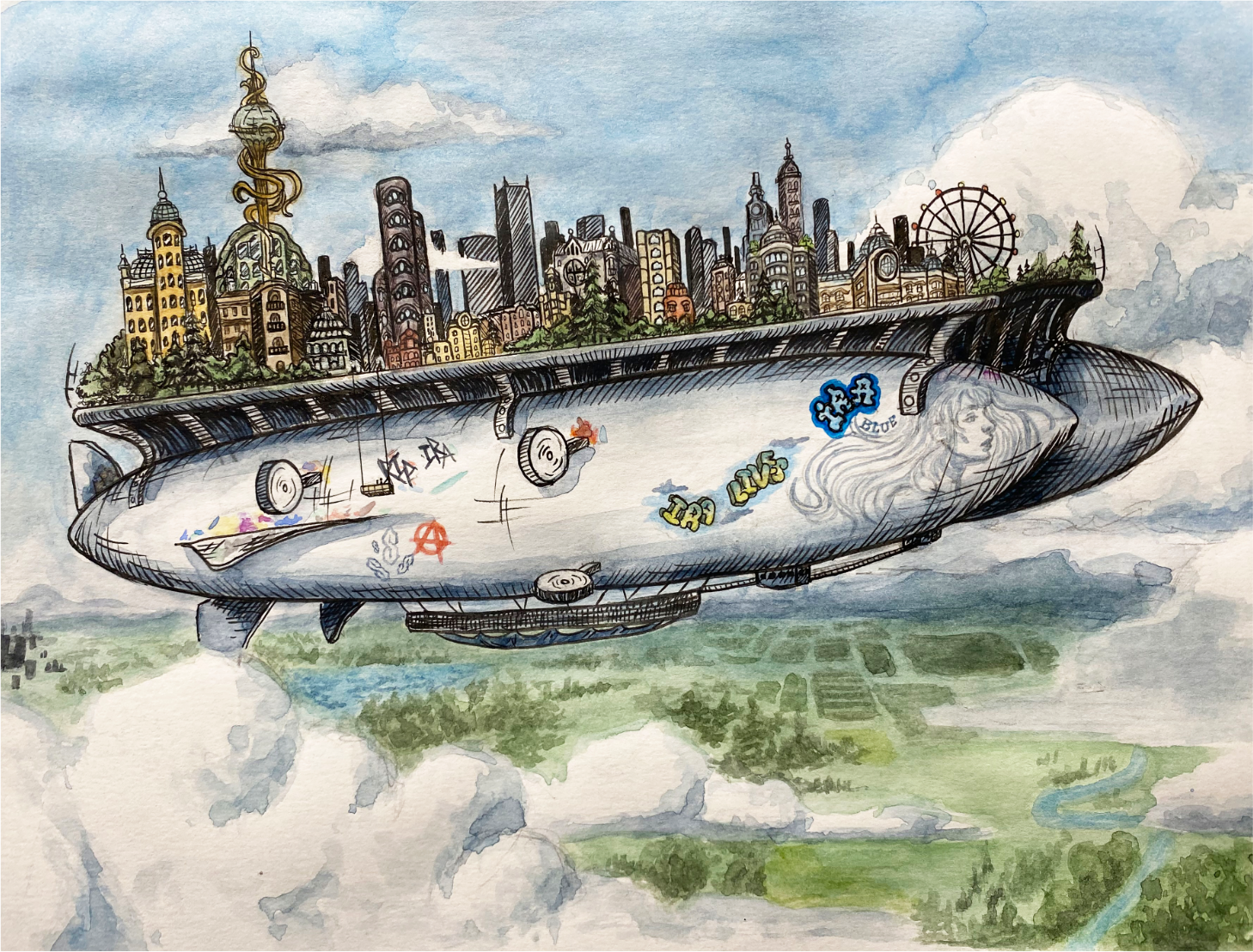
The first thing we see in ‘Touch Me in the Third Place’ (2084) is a typical establishing shot of hundreds of people, families, groups mingling about on a cloud-kissed summer day touching against the sky. Chunks of buildings perched on the sides of fields of trees, pines, mimicking almost a condensed Central Park with an Upper East and Upper West side. The shot lingers to allow clouds to slither across the frame, conjuring up the image of the entire thing as a colossal Titan, a mile-long nomadic shaft at once grinding against the earth yet so high, an angel’s conflagrant balls could brush against every passenger’s skull, with time left to linger on the foreheads of children and the oxygen-assisted elderly. A literal skyscraper. There is, thankfully, no accompanying soundtrack. Just the local ambiance of the crowds, which isn’t much better on the ears.
We see pans across graffiti on benches and sidewalks, posters, dancers, couples among the open courtyards. Vendors give away their paintings and t-shirt designs at their stalls. It’s controlled chaos in every bazaar, styles and cultural genres shifting wildly across time, but blended over with smooth calm transitions. Every place, every structure has multiple paths of entry. It is utility defying utility. The paths are full of maze-like lies and everyone is forced to know the downloadable map like they know their mother’s face. The trees warn the crowds that the most vital elements of the Third Place are hidden, visible only by dismantling everything, pulling at threads in the recesses. The effect it would all have is grotesque, if it weren’t so banal a choice for an introduction. It’s charming how openly it starts with cliché, aping every girl too attractive to be good at camerawork that wanted to make a movie about this cultural touchstone.
For over three long decades, THE THIRD PLACE has been the envy of every trend spot in the country, however much it is deserved. The artists and tech rebels that designed and launched it have thoroughly succeeded in their aim to craft the ultimate community center to end all community centers. It is the last rec center. Chances are, your parents met there, if they are of a certain age and cultural milieu. You were probably conceived up there. Most no longer care about its creators, but the film takes for granted the audience’s supposed knowledge of them.
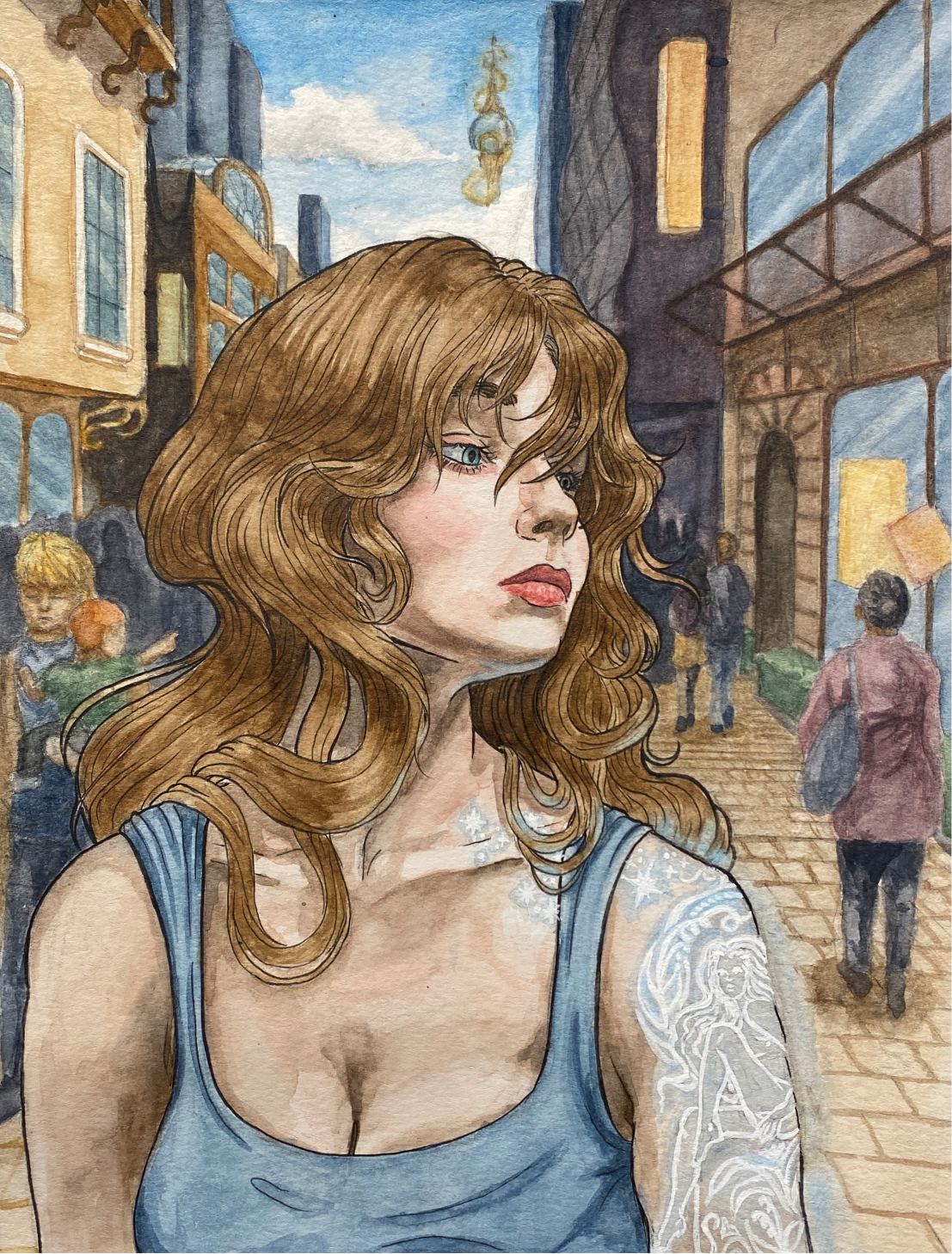
Molly Gernsback skips across Main Street, seeking her first charge. Someone holding a handheld camera tracks behind her. Gernsback sought a guerrilla-style for the shoot with only one crew-member. The camera, and its keeper, enjoy her; a toothy, anxious brunette long-practiced in good-looking. Her bracelets and rings of silver dematerialize and materialize at random intervals. Her cheekbones contain tiny implants that create an illusory effect of contouring and color. Her hair is in an almost semi-conscious state of flux as if the follicles could react to pain when cut. She has a winding track of dancing LED tattoos covering her exposed left shoulder, going down her arm in a sleeve stopping two-thirds before the wrist. When she was sure no one was looking, she would tweak just a little thing on everything about her, a minor hue change to the stars on her collarbone or her bangs just a centimeter longer, so imperceptible a change that you couldn’t be sure she didn’t always look like that. But she made sure the camera never missed a thing.
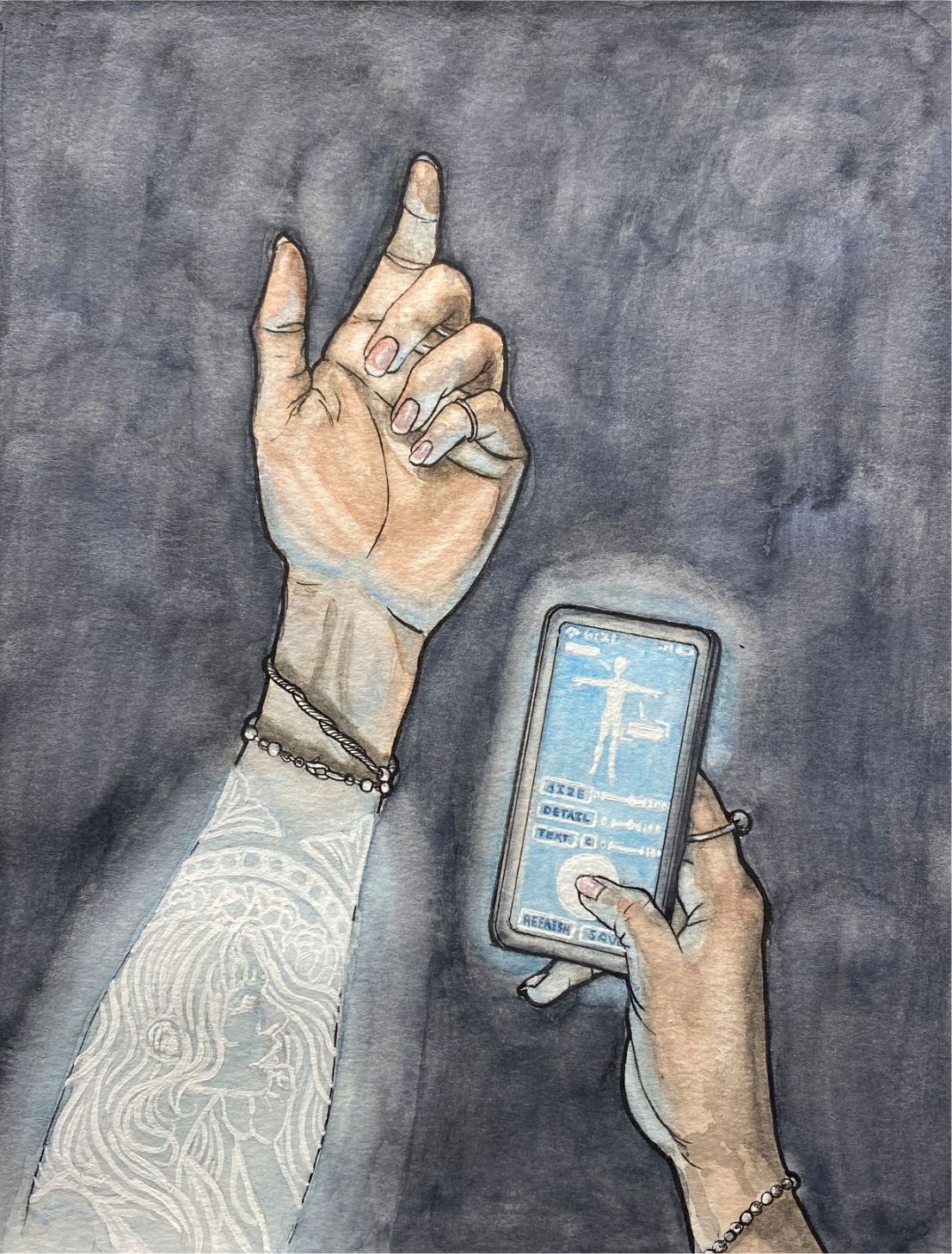
Before ever making a film, Molly achieved online fame as one of the early young adopters of the now popular procedure known as Angeling, wherein small hermaphroditic sea slugs of the class Gymnosomata are injected into the body, genetically designed to produce and release the metabolite Pteronone and specifically target certain hormones in the body directly, causing targeted growth of the breasts and buttocks over a period of five years at which point the sea angels die and are expelled. She feels resentful towards the fact that her sister also achieved notoriety for Angeling, but to treat a fatal thyroid issue. She felt judged by both the internet and her loved ones for being shallow when they never said a thing.
The first words we hear are Molly off-screen.
“What does The Third Place and Ira Blue mean to you?”
The prelap cuts to Molly sitting on a bench with a stony young man, stony like smooth stone caressed by clear spring water. Algae does not stick to him. He saves all his style for his facial expressions, a tiny bit for his hair and almost none for his everyday serviceable men’s fashion. The captions only identify him as The Tourist.
“Sorry, couldn’t tell you. I’m mostly here for my kid. It’s his first time.”
The Tourist tells Molly that his six-year-old son, Asher, is off with a babysitter somewhere on the ship. He’s a single dad.
“What do you do?”
“I’m a teamlead for software development. Mostly in Health IT.”
“Where’s his mom?”
“She died just before he turned two.”
She gave it space before continuing.
“I’m so sorry.” Even though there is never any good reason to, she offered up her own tragedy and he exchanged one back, tipping the scales. “My dad died a few years ago too.”
“Condolences. Team Dead Dad.”
He held out his hand for a high-five and she took it.
Molly explains to us that she met The Tourist about half an hour ago and asked him to be her cameraman, and her love interest.
“I get that I’m the weird one, but it still sucks you don’t know the story. When Ira Blue first came to THE THIRD PLACE with the original crew in 2051, she met one of the designers and they fell in love in like a weekend. It ended in tragedy after she became the ship’s muse and came up with most of its best ideas. I want what she had. I want to follow in her exact footsteps and fall in love with a hot guy and capture the whole thing on camera. I think she would love the idea.”
“It sounds like fun.”
Ira Blue likely would have said to Molly that her idea was DOA, as she had neither the charisma to carry the project, nor the talent to make the film work regardless. She would have approved of her taste in men.
The Tourist smiles at us in the way everyone smiles at the camera now, knowing the right way to, although less fine-tuned than most his age. If the background of the film was THE THIRD PLACE, then the foreground was how horny and lonely its principle leads were. While they walked through the park, Molly would occasionally reach behind the camera, giving The Tourist hidden touches or grabbing his hand to pull him along. At least she was smart enough to not ruin the fun by cutting it down with a joke about how hot and straight they both were. She would flip between speaking directly to him or the camera, or narrating over the footage.
“I knew if I wanted to find anyone in the know here, I’d have to go where the beautiful people are. Taking my new friend to B.A.T. would also be the best place for us to flirt. If you can’t have a good date at a bowling alley, then you shouldn’t date, period.” The next scene took us inside the lanes of the only flying cosmic bowling alley in the world, a favorite spot for teenagers, Bowling Alone Together.
Joining them was a couple in their 30’s Molly was friendly with, the notorious formerly rightwing cultural critic from Canada, Oscar Kastigan and his thin blonde girlfriend, the actress Therese James, who was making a splash in indie films. The Tourist filmed them stepping up to a sleek white machine giving off a blue light that would scan the shoes they came in with, and then deposit bowling shoes with a similar design. Ira’s greatest contribution to THE THIRD PLACE was the famous rule that there would be no places to buy or sell anything anywhere on the ship. Absolutely everything would be free. Being caught trying to exchange goods or services for money would be akin to being caught masturbating in public, but even more shameful.
After a moment of idling and watching the huddles of young folks drinking, bowling or dancing to the live set performing from across the bar, their ticket for a lane was called. At their table, Oscar took over the conversation while Molly would respond and Therese would smirk, sipping her drink with her legs laid across his lap. The camera was set stationary on the table so that all four of the group were in frame for the static, rather boring shot.
“No one’s worried we’re ever gonna get a McDonald’s up here. But we should absolutely be fucking terrified of the government turning it into a national park.”
“It would completely kill it!”
“Molly, it’s been dead for 20 years. Old people come up here at 7 AM to jog and their fat families come up here to take pictures, run around and scream. No offense.”
The Tourist waved it away. “I didn’t think you meant me.”
“No hate, but once teenage black girls find your secret spot, it’s no longer cool.”
“Isn’t teenage black girls finding your secret spot when it starts being cool?” The Tourist casually fought him and that made Molly smile. Oscar just laughed as she quickly changed the topic.
She obviously didn’t like Oscar but he was good content.
“What do you think Ira would think of how it’s changed?”
“She’d probably be disgusted. When Preepo’s built this place, if they didn’t like you, you didn’t fly. Yeah, okay, everything was free and it’s wonderful, but exclusivity. Gatekeeping. That was the thing. But I’m not saying anything you haven’t heard a million times.”
The Tourist had no idea what he was talking about. “Sorry, ‘Preepo’s’?”
“Pre-Po-Dec’s. They’re the group that designed and built The Third Place, out of a bunch of old abandoned shipping zeppelins.” Molly was embarrassed by his ignorance. She was about to explain but then Oscar did it for her.
“Pre-Post-Decadence was an art movement/collective, started by a bunch of rich New York and LA kids in the late Twenty-Forties, mostly writers, musicians, actors and people who do what I do.”
“What do you do?”
“Their belief was that beliefs weren’t even a thing anymore, just aesthetics. When the only shit making up an identity are the clothes you wear and which music you listen to, those truly are the most important things in reality. But it fucking sucks, right? We just keep spinning our wheels forever and ever, never doing anything new anymore. And everyone, even normies, had been saying it for like a century at that point, all the post-structuralists. They were mostly inspired by the Neo-Decadence movement of the Twenty-Twenties. They were waiting for a total collapse of all culture, like a total clean slate with a new era of humanity having a completely different way of creating culture. Their idea was to start a movement that knew, even if they couldn’t be alive to see it, they could at least shepherd it and get the world ready. Aesthetic Accelerationism. Do everything they hated about nostalgia and memes and fads… even harder. They were gonna be the last trendsetters and set in motion the death of trends.”
“Looks like it didn’t pan out.” Oscar laughed again. The Tourist was a quaint addition to the film. A blunt outsider to the outsiders, his feet were planted firmly on the ground even at five-thousand feet. The scene ended with him asking them one last question.
“So who’s Ira?”
Oscar smirked and held out his hand to Molly like a gentleman, well aware this was her lane.
“Ira Blue was like the princess muse of the Pre-Po-Dec’s. She was a ‘true artist’ in every sense. She was with them when they first launched The Third Place, and she helped make it famous. No buying or selling was her idea, not to mention, like, so many other amazing designs. She inspired everyone to be their most creative self. I was inspired to become a filmmaker because of her. Everyone remembers her for her wild antics like streaking across the park and always screaming at people, but they all loved her. When she first arrived, she fell in love with one of the original founders of the movement, and after a few years, they broke up and never spoke to each other again. But everything she did made her fabulously wealthy, and she chose to go into isolation. Personally, I believe the theory that she’s secretly some super famous actress living under a different identity.”
Then Therese chimed in for the first time. “Wasn’t she like 15?”
“No, I hate that rumor. It’s not true.” She only faced The Tourist, as if he said it.
“Sorry, it’s what I always heard. That when she joined, all the guys wanted to fuck her and basically passed her around and got her addicted to drugs. I always thought that whole scene sounded like a bunch of bored losers.”
Oscar took a sip of his drink before jumping from that. “And they killed her!”
The Tourist perked up at that. “Like literally?”
“They did not!”
“She had dirt on some of them, like that they raped her. So they threw her off the ship.” He raises a finger then slowly trails it down to the table with a whistle and then exhales a boom.
“Isn’t there a giant wall around the whole thing so you can’t do that, or jump off?”
“Yeah, but if anyone would know a way past that, it’d be them. And they say the whole place is haunted, riiiight Molly?”
Molly rolled her eyes. “Yeah, like her ghost haunts couples on dates and dooms relationships to fail.”
The Tourist chuckled. “Damn, that sucks for us, then.” Everyone but Molly smiled at his joke.
Then he broke the silence. “So, are we gonna actually bowl or…”
After a few shots of them group bowling, the film cut to just Molly and the Tourist sitting at a booth in an extremely tiny neon-blasted Chinese restaurant, their legs close enough to lock into each other. The camera rested on the table against the wall, the two of them on each end of the frame and the whole of the restaurant in the background. In the dead-center of frame, a Dali painting was hung. This was the only good shot in the film.
“Fuck them.”
“Is this going in the movie?”
“It’s all going in. Fuck them. They don’t know what they’re talking about.”
Molly pulled out her phone and tweaked the shapes on her arm, just to keep herself busy and distracted. He watched her, as do we, do this for about a minute. When she turns her entire arm the color blue, he suddenly takes it, entranced.
“I first learned about The Third Place from Ira’s posts online. She’d always gossip without naming anyone, or talk about the wild things that happened to her that week. She’d also write really amazing reviews of films or performances or art exhibits. Getting a good review from her was everything. The best posts of hers were from that first year. A lot of them were about her boyfriend, and the way she described their relationship was always so so hot. She said her favorite thing to do was try to talk in between kisses. Like try to say a couple words and he’d keep interrupting her with a kiss. But only if it was spontaneous, not planned. And now to me that’s forever gonna be the hottest thing a couple can do. I’d probably just cum immediately if I did it up here.”
“I’ll keep that in mind. You really love this place.”
“No, not really. I’m actually glad you didn’t get all excited about it. That’s why I wanted your help. I actually… don’t feel much of anything when I’m up here. I wish I could see what she saw. It’s true she had a lot of issues, but everything she represents is really important to art history.”
“I think maybe she’d care more about whether or not she had a good life than what it represented.”
Molly squinted and smiled, like he was a precocious child telling her his dog could talk. “That’s really sweet, but you’re so wrong. The only thing that mattered to her was that. Like I represent stuck young women who refuse to let radical change die. And you represent young men who refuse to let family values die.”
“I don’t care if family values, whatever that means, dies. I care if I die? I care if Asher dies.”
“Okay, I get it. You’re stuck trying to do the twenty-thirties thing, while I’m stuck trying to do the twenty-fifties thing, and everyone else is stuck trying to do the twenty-eighties thing right now.”
“I’m just stuck trying to raise a kid.”
“Ha, see, I set you up! That’s the most twenty-thirties thing you could have possible said.”
“Okay, but could people in the twenty-thirties do this?” He tented his fingers and held out his shoulders, waving his arms into a smooth wave.
“Pfffffft… No, that’s all you!”
“Could they do this?” He brought his left elbow pit to his mouth and blew, expelling a loud fart.
Molly burst into laughter, looking around as she pulled on his hands. “Stop!”
The scene ended on a cute note as they both giggled, but the question remains: What is the point and why should we care?
Molly’s narration clued us into their next destination, where the film took an unexpected turn.
“My friend texted me that some journalist for some website was interviewing her and other people at the Third Place gym.”
Just outside the gym, the Tourist filmed Molly watching the journalist interview an older man. She started by asking him mindless questions about his reasons for visiting The Third Place and his favorite things he’s seen there. Then finally, she asked him who he was planning to vote for in, what was at the time, the upcoming presidential election. As always, the response becomes even more painful in hindsight.
“I shouldn’t bother her when she’s doing her job.”
When she saw the man walk away, Molly walked up to the tall, put-together journalist. Her gaze was friendly, but pointed still. Every person could be something to her. She fixes up her hair, noticing the camera before Molly even gets to her.
“Are you a journalist?”
She smiled. “I am. Just getting a feel for where things are politically. I have a theory there are a lot of people on the right in enclaves up here. May I ask you some questions?”
Molly gestures to the camera. “I’m actually shooting a documentary and doing interviews too! It’s just a lame student film, about Ira Blue’s legacy on The Third Place and art and stuff like that.”
“I love that. The character was certainly more important than the people who created her. You know, all the scummy fascist-lite techists that built it. If Ira was real, I don’t think she’d be very happy.”
“Ira was completely real. You don’t know what you’re talking about.”
“I was under the impression that it was common knowledge that Ira was a made up story by the arts community up here. I thought it was cute, if a little morbid.”
“Vultures coming up here with no clue and disrespecting the culture and turning it into content and politics.”
She shifted, uncomfortable at Molly’s immature ranting, but she let her say her piece.
“Molly, it’s okay.”
“We’re both interviewing people up here, sis. It’s not a competition.”
“That’s completely different! I’m just trying to honor one of my heroes with my crappy student film. You’re working for some media company shoveling propaganda.”
“Sorry, what’s your name again?”
“Molly Gernsback, and please, feel free to write about me, bitch!”
Molly stormed out of frame, the camera holding for a moment, then cutting to black.
We join Molly and The Tourist again on a park bench. The blue hue of approaching dusk shades every inch of the île flottante.
“I don’t know what’s wrong with me.”
“That was pretty crazy.”
She looks up at him and frowns, disappointed with that response. “Isn’t it crazy to be following around a student filmmaker when you have a kid to raise?”
“I’m just trying to have a little fun with a cool girl.”
“This isn’t supposed to be fun. It’s supposed to be meaningful.”
Molly lets out a groan, standing up off the bench. “I don’t think this is working, I’m sorry. Call it self-sabotage if you want, but I don’t like feeling like a loser next to you.”
He tried to calm her but it just made her tear up. It wasn’t long before Molly took her camera and as quickly as they had met, they went their separate ways.
It was at this moment, when Molly was alone with her camera, that I realized The Tourist would receive a phone call from me.
You see, I am Ira Blue and The Tourist is my son. Watching Molly’s film had not been the most enjoyable experience, but it was an illuminating one. I was always happy to see more of my son even on a screen, and Molly amused me. She knew so much about me from what I wrote and nothing from how I lived. And she knew absolutely nothing about the scene. I had to hold in murmurs of disgust watching her poorly paced, amateur attempt at wringing creativity out of a naive girl’s personal account of my supposed iconography. But I did keep watching. And then my son called.
He told me almost everything. The intimate details he didn’t I could glean from the film. He was very much into her. He only took after me in his adaptability. In every other way, my son and I were very different. I think his practicality was rebellion against my instability.
“She sounds a little nutty.”
“Maybe, but I still really like her. Is that bad?”
“No, that’s good.”
He asked me what he should do, and I told him to give her some time, and if she didn’t come looking for him, he could look for her. He said he wanted to introduce her to Asher.
Her film wasn’t over. She meant it when she said she would follow my footsteps. Every hangout spot I posted about, pictures I took. Graffiti I made others do for me. The trees and flowers I planted. She filmed them all, and much more. Street performances and cooks and students doing homework and the stars in the sky. The closest the film ever got to capturing what I felt up there was right then, when Molly stewed in self-hatred.
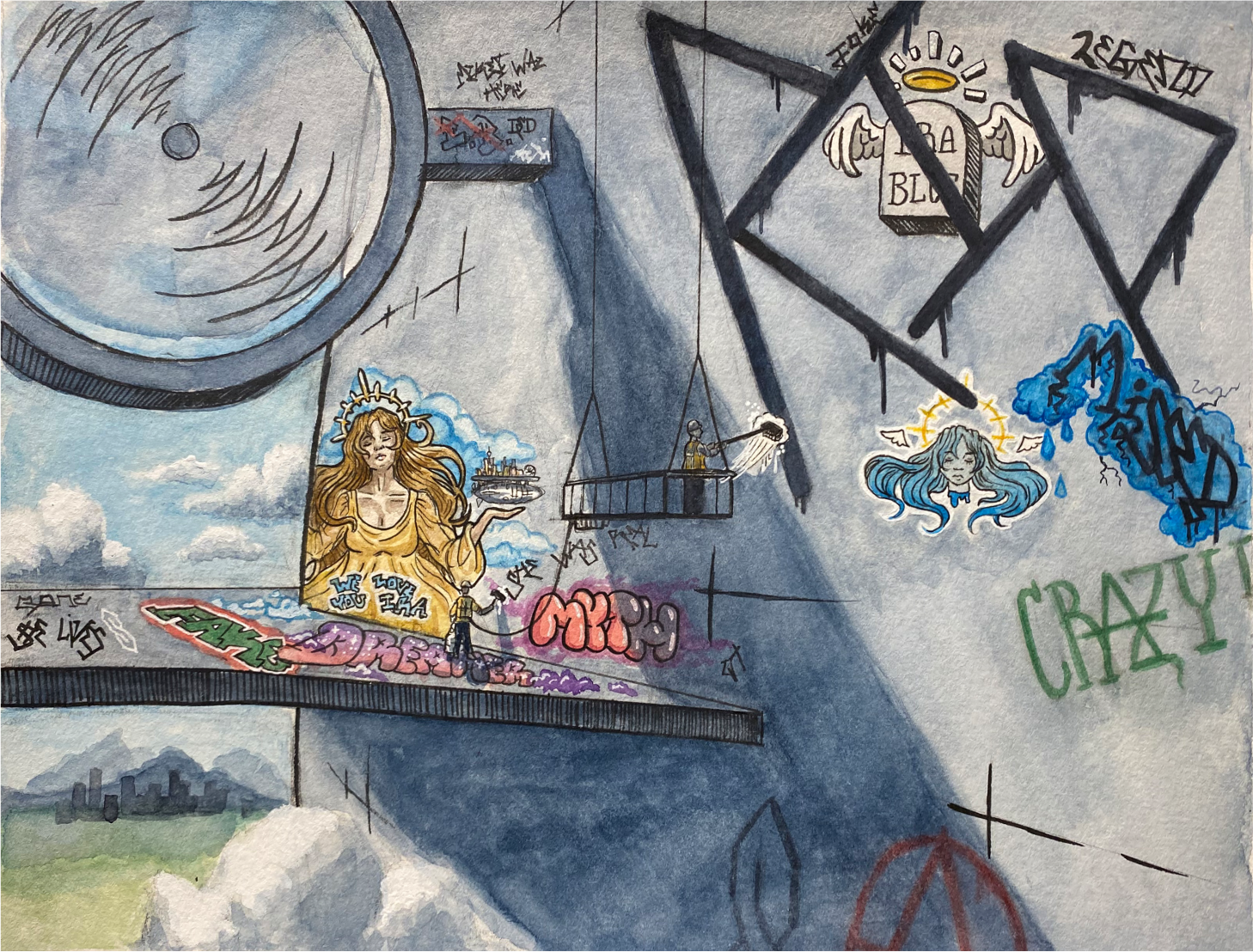
And then she sat cross-legged in the grass, bikers and couples strolling on the sidewalk behind her. She turned the camera up towards herself, her face right up close to the screen.
“Ira, I really wish I could talk to you. It’s so hard. I never talk about but, I hear things when no one is there. I feel eyes on me all the time. I’m sorry, this is so hard. Nothing I say, is getting through!”
Her words stammered and her breath was shaky. She would wince and pause and sigh. Both silence and speech caused her great pain. Every attempt to be genuine, to say something sincere was threatened to stand down by the knowledge that it would contain an element of performance, of self-doubt and irony. No matter what she said, it could not stand on its own, no matter how much she wanted it to.
“There’s nothing I can say to you or the camera or anyone that feels real anymore.” She stared at the ground for a long time, thinking and searching. I was tempted to scrub the video forever, but then she spoke.
“I wish he was here.”
She found my son, and he was still on the phone with me. He glanced over and smiled at the camera. Just as he hung up, Asher entered the frame, running across the park.
“Ash! Hold up!”
She locked the camera right on Asher as my son grabbed him and walked him closer to her. He wasn’t at all shy in front of the camera, but like their parents, few children ever are anymore.
“Ash, this is my friend, Molly.”
“Hi.”
“Hey, Asher! You’re way cuter than your dad said.” That made him bashful.
The three of them went on a nighttime walk through the park, Molly filming everything Asher did, which was mostly run around and point at art installations he thought looked cool. My son groaned when Asher noticed the pool and begged to go in. When his father refused, Asher became especially grumpy. Asher was very good at chess, especially for a six-year-old, and my favorite shot in the film is the frowned up little face of a child that can only think about the pool staring down at a chessboard across from a cheerful old man happy to be beaten at his favorite game.
At one point, Molly gave the camera to my son, and she ran ahead to join Asher staring up at was likely a plane.
“It’s a rocket!”
Molly giggled, and then after a moment, joined in. “A rocket?!”
“Yeah!”
“Ashy, it’s probably space pirates!”
“Whaaat? It can’t be!” Asher was a kid that would knowingly repeat phrases he saw on TV like ‘Aw, shucks!’ because he thought it made him look cute, and it did.
“They’ve been trying to take over the entire skyship for YEARS! You have to help us find a way to beat them.”
“Okay! You have to help, dad!”
He ran up to join them, and knew in that moment to put the camera not on Asher, but on Molly. The last shot of the film is her looking around the entirety of the park, seeing all of The Third Place for the first time.
How perfect and adorable and mediocre, to end the film with a sentimental message about the importance of remembering the simple things like imagination and walks in the park. All it takes is a particularly cute child at play and you can turn the most obvious tropes into transcendent fluff. Even my own grandchild could not save it, and there’s never been and never will be a child cuter.
I attended the premiere of this ridiculous girl’s Titanic ‘sequel’ on my birthday and was given Special Thanks in the credits. The silent gratitude she and I shared at dinner beforehand would have sufficed. She and my son lit up the room, and had become almost as one person, able to turn a dreadful night into a bearable one. And then at so slight a moment I almost missed it, as Molly was fretting with her usual anxious manner about some minutia of the event, my son interrupted her with a spoonful of ice cream at her lips. She smiled and accepted it, and then continued.
As if by instinct, I giggle, touching two fingers to my own bottom lip and suddenly I lose myself. I forget anything I learned, what little I ever did.
When I was little, when I went to the local mall with my mom, we went into an antique store and they had a very large painting. It was Dali’s Dream Caused by the Flight of a Bee Around a Pomegranate a Second Before Awakening. I will never forget how much the scene unsettled me: The woman lying naked on a shaft of frigid ice in an empty sea, giant tigers leaping out of the mouths of tigers, leaping out of the mouth of a fish bursting from a citrus fruit like an egg sac, bayonets shooting out of their mouths and pricking her skin. The only part of the painting that didn’t give me such anxiety was the cheerful circus elephant, unless I began picturing too hard its colossal stilt legs reaching all the way down to the bottom of the black ocean and it became nightmarish again. The scene was so real, I imagined what it would feel like to actually be that naked woman on the ice in that moment and how a contented, sexy pose would be the last thing I could want to do in that situation. As a six or seven-year-old, I imagined I’d much rather just scream and cry and the chill that it gives me whenever I think about it or see the painting will never leave me. I could imagine no torment greater than being nude trapped on a tiny frozen island of ice, and still I struggle to imagine one. I think the part that brought the greatest fear was knowing there was no conceivable way I arrived in that situation. I didn’t take a boat, I wasn’t left there and I definitely didn’t swim because I couldn’t swim when I was six. I just woke up and there I was, naked on the ice with tigers leaping at me. Whenever I think about the fear that painting stirs in me, it makes me very happy to be reminded of the power of art on the individual.
I realized I would never see what my son sees in you. I realized I would never know who you are, only then did I knew who you are. I’m in the theater and your film starts and I throw myself into Leo’s acting and in that dark portal into nights and dreams, I blow my pathetic whistle and float on the ice. I just float, not dead here, but alive, slowly forward. When I see you’ve used the painting again, I wonder, did you know? As I watch the space-station explode and the bodies of couples in passionate dying embrace drift out into space, I’m overcome with a feeling that all the artists on THE THIRD PLACE could never give me in all those years: That we’ve avoided disaster, and art will be okay.
I’ll be okay.